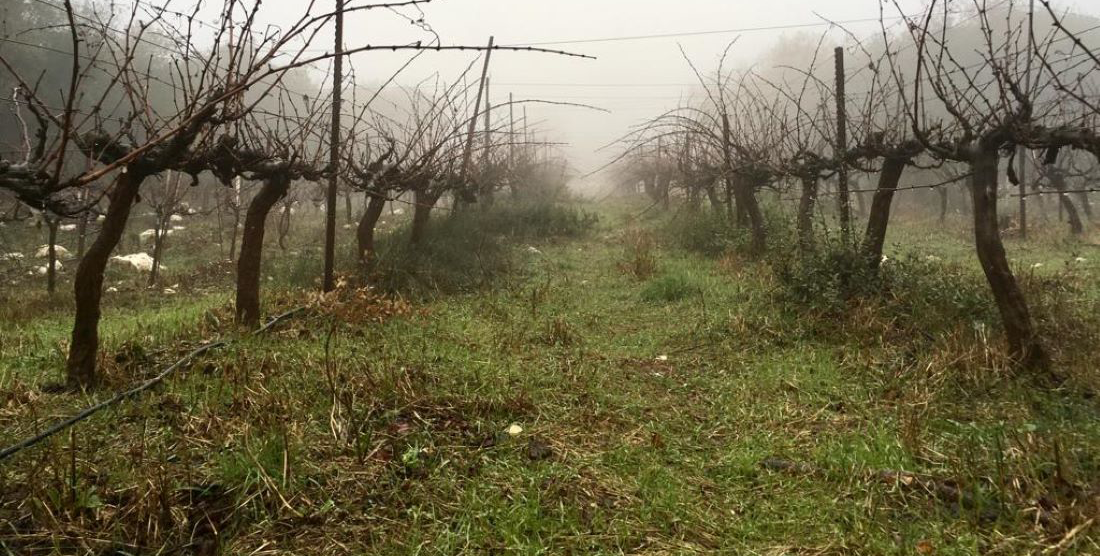
Article: The Meaning of the Land
The Meaning of the Land
By Yuval Erlich Nitzan
So let's get on the same page -
Soil begins as a collection of minerals. Rocks finely ground by millions of years of pressure and erosion provide the foundation. These minerals vary from place to place - in some areas, these will be rocks of volcanic origin, others will be sedimentary rocks, and in some places, sand is the primary basis for the soil. Soil tests will tell us which minerals are present in the soil - nitrogen, potassium, calcium, phosphorus, iron, magnesium, and more…
But minerals are only the skeleton upon which living soil is built. The component I find most interesting, most vital for plant health, and the one over which we have the greatest influence, is the living component in the soil.
The soil food web is complex and fed by organic matter like decaying plants, animals, and microbes, as well as nutrients released from plant roots. Organic matter is digested by bacteria, fungi, and other life forms, which in turn are eaten by worms, insects, and spiders. Finally, larger animals like mice and voles living in the soil eat the insects.
All living creatures need food and strive to grow and reproduce. As a result of feeding, reproduction, and mortality processes, additional nutrients are released, and the soil structure continues to develop.
Meanwhile, this diagram can help.

The biodynamic perspective attempts to see the complete picture. The entire world, according to this view, is a living, pulsating system of connections. The earth itself is perceived as a living organism.
Plants emerge from this organism, and it is difficult to precisely separate where the root ends and the soil begins. Therefore, observing the living components in a plot of land can provide us with broad and essential information. A microscopic examination of a soil sample will show us the diversity of microscopic life in the soil, and a chromatography test will give us a fascinating picture of the living forces within the soil.
Steiner identified a weakening of the life force in the soil with the introduction of chemical practices in agriculture in the early 20th century. He gave the famous series of lectures on agriculture to provide the knowledge and tools to restore that force to the soil. That same soil from which the plants grow that we and our animals feed on. Nutrition that affects us not only physically but also our spirit and soul. The same weakening he identified in the soil, he also identified in the human spirit, connecting these phenomena.
From this holistic view, biodynamic agriculture places significant emphasis on building living soil, with the understanding that the soil and the life within it are part of a vast web, built from the smallest bacteria through larger creatures, all the way to the moon, planets, and the entire universe. The parts of the web influence and are influenced by each other, and to understand one part, one must grasp the complete picture.
Some biodynamic practices are very simple to understand, others are more difficult to grasp. One needs to delve deep into them and let go a little of the Western intellect with which we are accustomed to perceiving reality.
It starts with practices of preserving biodiversity and preventing erosion, practices that have even been adopted by conventional sustainable agriculture. The biodynamic standard dedicates an entire chapter to this topic.
It continues with the use of biodynamic compost as the primary fertilizer (compost is a broad topic that we will delve into later). In addition, biodynamic preparations are applied, which work at a homeopathic level and support life processes at various levels.
In short, these are the preparations that act on the soil:
Preparation 500 (Horn Manure) - The first basic preparation. It is very rich in essential microorganisms on one hand, and energetic life forces on the other. It accelerates humus formation, helps root system development, and balances the decomposing energy coming from the cosmos.
Preparation CPP or 'Concentrated Compost' - developed by Maria Thun. As its name suggests, it is a concentrated biodynamic compost that contains the six compost preparations and is applied to the soil by spraying, sometimes in addition to preparation 500 and sometimes separately. It is also rich in microorganisms but also contains the six compost preparations 502 to 507. This preparation is intended to bring the effect of the compost preparations to areas where the application of classic biodynamic compost is too operationally complex.
Preparation 500P - a later development by Alex Podolinsky. This preparation combines preparation 500 with the compost preparations and is also intended to bring its effect to large areas without the need for spreading classic compost.

In the world of wine, great importance is attributed to the soil. The connection between wine and the soil it grows on has been recognized for hundreds and thousands of years, but not necessarily in its full extent. The term 'terroir' primarily refers to the geological structure of the soil, and indeed, various wine regions boast complex geological structures in their soils - limestone soil, volcanic soil, combinations of sand with flint and clay, and much more. A lot of weight is given to the type of soil, and rightly so. To this, air directions, altitude, slope, proximity to a water source, and more are added.
But the living part of the soil is hardly discussed. In many cases, it is even actively harmed, which is a shame.
Because if a mineral structure is unique to a place, then a biological texture is exponentially more unique. It is influenced by a combination of minerals and the various plants growing in it, and also changes from year to year depending on the weather. Its influence on the vine is immense and therefore also on the taste of the wine.
But more than anything, beyond taste, originality, and the quality of the wine, which are positively affected by living and healthy soil - the word 'responsibility' plays a central role here. Especially today, in an era of global warming, climate crisis, and cross-continental pandemics, a heavy responsibility rests on farmers. A large part of the Earth's surface is entrusted to us; it is our responsibility to leave the soil in these areas alive and healthy, with as wide a biological diversity as possible.
The good news is that we have the ability to restore it to this state. According to many studies, if soil conservation practices are implemented on agricultural lands on a large scale, the climate crisis can actually be halted.

The choice and ability are in our hands; no advanced technology or large financial investment is required here.
The knowledge and experience in the field have existed for decades, backed by research. The wheel can turn to the other side.