Article: The Secret Life of Vines
The Secret Life of Vines
The Secret Life of Vines
I recently read an article published in Jancis Robinson's magazine titled: "Biodynamics - Is a new approach needed?"
Winemaker Katia Nussbaum from the Montalcino region in Tuscany recounts her encounter with the book "The Hidden Life of Trees" by German forester Peter Wohlleben. This encounter sparked questions, reflections, and insights regarding the vineyard she cultivates.
By Yuval Ehrlich Nitzan.
In Eran's (Gadi's father) library, I found a copy of the book in Hebrew. A small, friendly book with a modest cover. A simple illustration of the internal rings of a cut tree adorns it. Not exactly what one would expect from such a dramatic title.
This modesty continues within the book's pages, where the elderly forester shares his impressions from his work as a keeper of an ancient primary forest in Western Germany. His impressions and feelings are presented alongside short summaries of various scientific studies, revealing the hidden world of trees. The conceptual world Peter applies to trees is highly unconventional and raises quite a few questions. Words like community, family, pain, sadness, and joy, words usually used in the context of humans and other advanced animals, are written here in the context of creatures with roots, trunks, branches, and leaves.
Do forest trees communicate with each other? Do they care for each other? Do they feel pain? According to Peter, absolutely yes.
There is a clear evolutionary advantage to communication and support among trees, and they achieve this in various ways. One of the fascinating communication methods is through the forest's internet – the mushroom kingdom. This is a magnificent kingdom, a vast network of living hyphae connecting the roots of trees. Through this network, trees transmit various messages and, in certain situations, even nutrients or water. According to Dr. Elaine Ingham, the trees themselves take care to feed and maintain the fungal network. Approximately 40% of photosynthesis products are not used by the plant for its own nourishment - but for nourishing the microorganisms living near its roots! A tree or shrub will ensure to send nutrients that are more suitable for fungi. An annual plant will send nutrients primarily preferred by bacteria.
40% of photosynthesis products! This is an enormous amount of sugars and proteins released through the roots, nourishing various life forms and not the plant itself at all.
Why does the plant do this? It seems that the interactions between the plant and the various microorganisms in the soil are so profound that it is impossible to imagine the living world developing without them. Relationships of mutual nourishment, support, and also protection from pathogens.
The roots of some trees literally connect underground, while others connect through the fungal network. Science is already beginning to describe the forest as a massive super-organism, which can spread over many kilometers and cares for its different parts. It moves nutrients and water to areas where they are lacking and also transmits messages. A notification about an approaching parasite, and even large animals that simply devour tree leaves, can pass through the underground network or via pheromones in the air. In response, the tree will concentrate tannins or terpenes at the tips of its leaves, making their taste less attractive.
And this is interesting because conventional science has been examining the subject for decades in many studies, from various, mostly microscopic, angles. But the relatively new term 'superorganism' already appeared in the 1920s among Rudolf Steiner's lectures. Even then, he suggested looking at the farm, for example, as a living organism. A single organism connected to various organisms in its vicinity. According to Steiner, plants and animals should not be understood as isolated individuals in the area but as part of one large entity, of which humans are also a part.
Steiner tries to look at the world from the other side of the telescope. When he "zooms in," he also makes sure to "zoom out." Just as one cannot understand the movement of a compass needle without looking at the Earth's magnetic poles, he suggests always looking for the big picture. Steiner, unlike Ingham, is not very impressed by the microorganisms in the soil. He does not claim that they are unimportant or do not play a significant role, but no more than the role of other parts of the large organism. According to Steiner, the organisms in the soil are merely a sign of health and balance at various levels. Just as flies in a room only indicate that the room is dirty. If we remove all the flies, the room will not become clean. If we bring in flies, it does not mean the room is dirty.
It's nice to wander through these different perspectives. Between Ingham and Steiner, and with Wohlleben in his primary forest.
But something in Wohlleben's writing, in his closeness to trees, touched me in a hidden place.
From my childhood in Harashim, among the forest trees, I remember experiences of barefoot wandering among the trees, feelings of walking among living creatures with character and emotions. Sometimes a hand would be placed on a tree trunk and imaginations of a conversation with that tree would begin to develop. The truth is that even today, every few months I find myself placing my hand or head on a tree trunk or a wide branch in the forest for a certain period of time.
Steiner attaches great importance to the intimate connection between the farmer and what they cultivate, and with the nature around them. A direct, personal, sometimes intuitive connection. In his view, human health and soil health are intertwined.
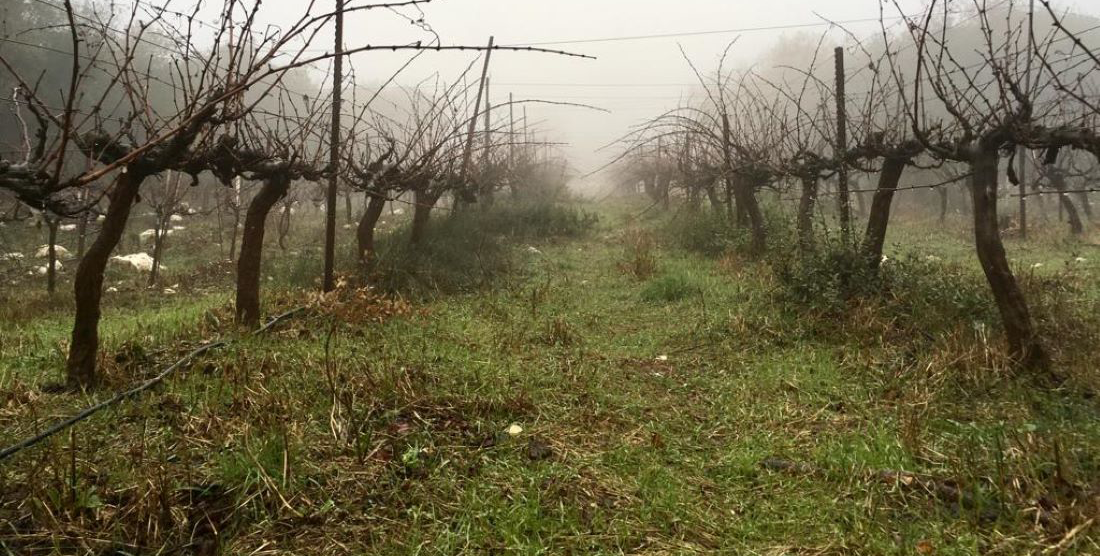
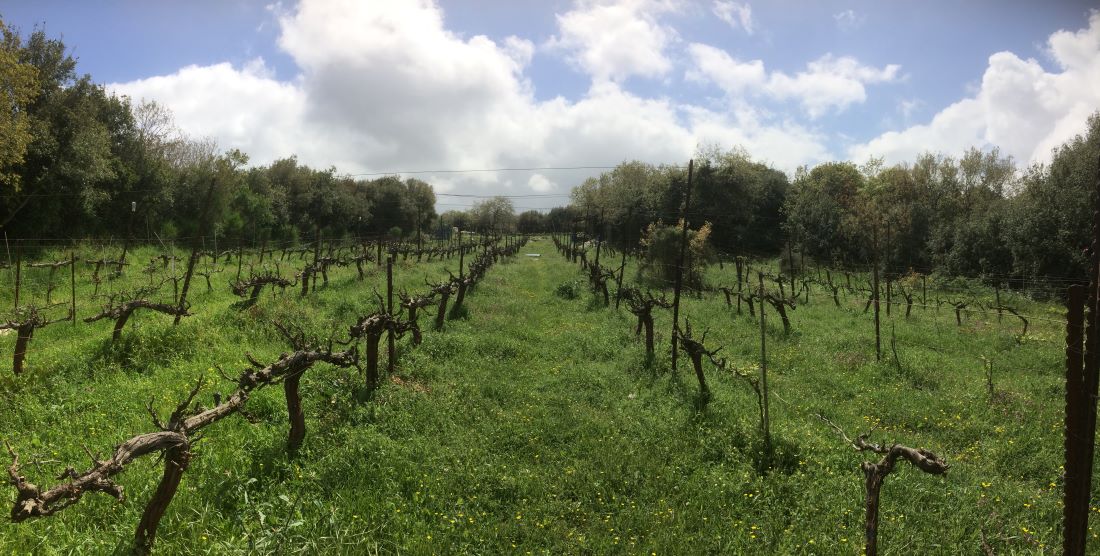
The vineyard in Harashim is surrounded by forest, and it turns out it is not separate from it. Apparently, the vines communicate with each other, with the annual plants growing in the vineyard soil, and also with the trees growing nearby.
And still, many questions remained unanswered for me. What is the extent of communication? Does a plant that started its life in a nursery communicate with its surroundings like one that germinated in the soil where it grew? Can a vine grafted with a rootstock and scion establish interactions like an ungrafted vine? How do different grape varieties in the same vineyard affect each other?
Among the vines in the Harashim vineyard, forest trees sprouted over the years. Some have been there for many years right next to the vines (we prune them back to ground level every year so they don't take over). The roots of these vines and trees are probably intertwined. And the question arises – does the vine, which is originally a climbing plant on forest trees, benefit from this proximity to the trees? Is there competition or interaction between them? And what is our true role within the whole organism?
A hidden and fascinating world. Sometimes one part is illuminated and additional information is revealed, but along with it, new dimensions remain hidden in darkness.
And perhaps it's good that way, and not everything needs to be illuminated. Without the shadows, the picture becomes flat.